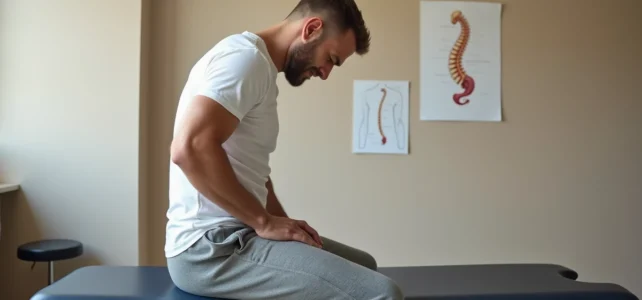
Sciatica refers to pain caused by irritation or compression of the sciatic nerve, the longest nerve in the human body. This nerve originates from the lumbar region, passes deep through the buttock, and then descends along the back of the thigh to the foot. When the pain is concentrated in the gluteal muscles without extending further down, the underlying mechanism is not always what one might assume.
Truncated sciatica and buttock pain: a mechanism often misidentified
In a classic lumbar radiculopathy, the pain follows the complete path of the sciatic nerve, from the lower back to the foot. The presentation is recognizable: burning or electric shock sensations along the leg, sometimes accompanied by tingling in the toes.
There is a distinct form, sometimes referred to as truncated sciatica. The pain and paresthesia remain limited to the buttock and the upper thigh, without following the complete path down to the foot. This clinical distinction explains why some patients experience intense pain in the gluteal muscle while their lumbar examinations reveal nothing alarming.
Understanding the impact of sciatica on buttock pain requires looking beyond the lumbar spine, directly into the thickness of the gluteal muscles.

Piriformis syndrome: when the gluteal muscle compresses the sciatic nerve
The piriformis muscle is a small deep muscle located beneath the gluteus maximus. It connects the sacrum to the top of the femur and is involved in external rotation of the hip. The sciatic nerve passes just beneath this muscle, sometimes even through its fibers depending on anatomical variations.
When the piriformis contracts for an extended period or goes into spasm, it can directly compress the trunk of the sciatic nerve. The resulting pain is localized deep in the buttock, often perceived as a dull ache or burning sensation behind the hip.
Differentiating piriformis syndrome from a herniated disc
Confusion between these two origins is common, as the symptoms overlap. Several elements point towards the piriformis rather than lumbar radicular compression:
- The pain worsens with prolonged sitting, especially on a hard surface, and decreases when walking or standing.
- Deep palpation of the buttock reproduces the pain, while lumbar spine tension maneuvers remain negative.
- The pain generally does not extend beyond the knee, unlike a herniated disc which often radiates down to the foot.
A precise diagnosis relies on clinical examination. Lumbar imaging (MRI, CT scan) is primarily used to rule out a herniated disc or spinal canal narrowing.
Contractions of the deep gluteal muscles and functional nerve compression
The piriformis does not act alone. Several deep gluteal muscles (internal obturators, superior and inferior gemelli) surround the sciatic nerve in its pelvic passage. Prolonged contractions of these deep gluteal muscles can create functional compression of the nerve, even in the absence of any disc pathology.
This type of compression often occurs in individuals who sit for long hours, adopt asymmetrical postures, or have muscular imbalances in the pelvis. The sustained sitting position shortens the piriformis and deep rotators, which eventually contract permanently.
Muscle tension maintained by the pain itself
A cycle is established: the irritated nerve causes pain in the buttock region, and this pain leads to a reflex contraction of the surrounding muscles. This contraction exacerbates the nerve compression, which intensifies the pain. The gluteal muscle tension becomes both a consequence and a maintaining factor of sciatica.
This pain-contraction-compression loop mechanism explains why some buttock sciatic pains persist for weeks even after the initial cause (a slight disc bulge, a temporary overload) has disappeared.

Exercises and targeted management of sciatic buttock pain
Management differs depending on whether the compression is at the lumbar level or in the buttock itself. For functional compression related to the deep gluteal muscles, the work focuses on two complementary axes.
The first is to relax the spasming muscles. Stretching the piriformis, done by bringing the knee towards the opposite shoulder while lying down, allows for gradual elongation of the muscle and reduction of pressure on the nerve. These piriformis stretching exercises should be held for several tens of seconds to produce real relaxation.
The second axis aims to strengthen the stabilizing muscles of the pelvis (gluteus medius, transverse abdominal) to correct postural imbalances that promote compression. A physiotherapist can guide this work by adapting the exercises to the patient’s tolerance.
- Avoid prolonged sitting, especially on hard surfaces, and alternate positions every thirty to forty minutes.
- Avoid crossing legs while sitting, as this shortens the piriformis on the crossed side.
- Apply heat to the buttock before stretching to facilitate muscle relaxation.
Medication (anti-inflammatories, analgesics) alleviates the inflammatory component but does not correct the underlying muscular imbalance. Without active work on the gluteal muscles, recurrence remains likely.
Buttock pain related to sciatica is not always a reflection of a back problem. A local compression of the nerve by the deep gluteal muscles produces a similar presentation, with different treatment and prognosis. Precisely identifying the level of compression changes the direction of the entire management.