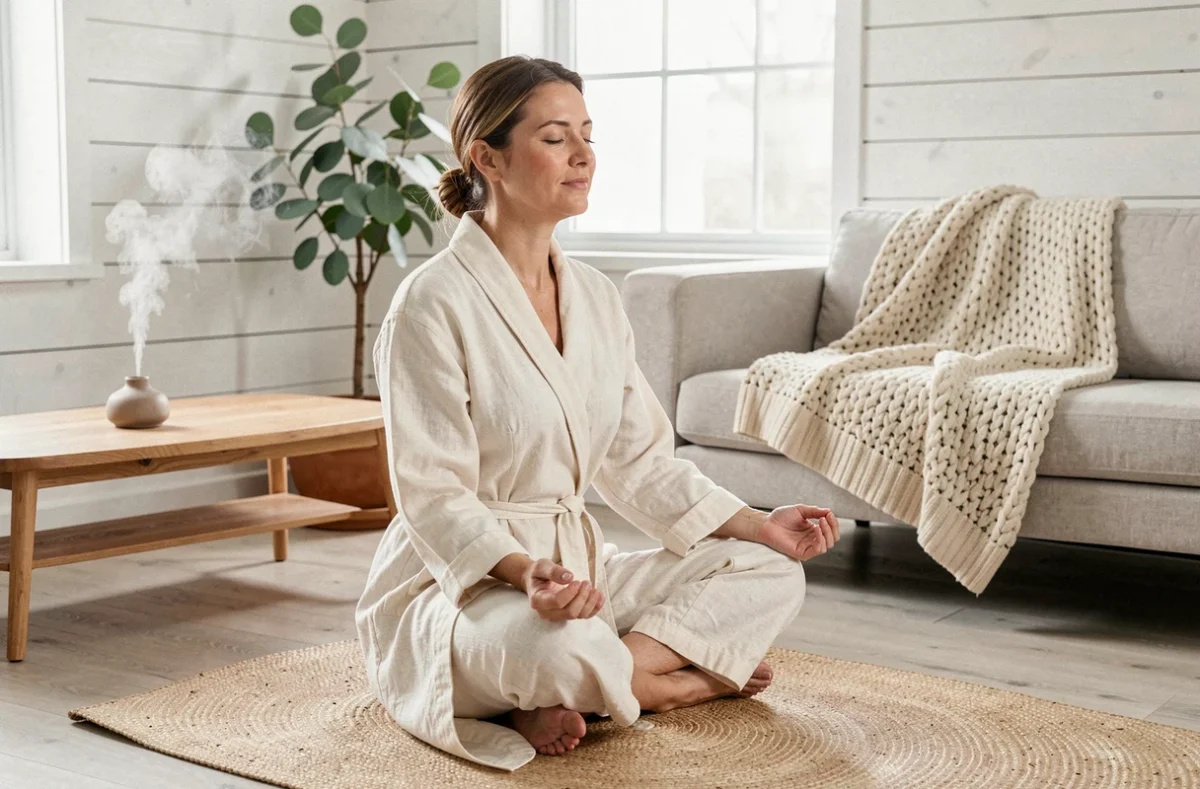
Transforming a house into a wellness space is not just about choosing a cushion or a scented candle. It relies on technical parameters that most decorative articles overlook: indoor air quality, humidity management, and summer thermal comfort. Here, we address the concrete levers that sustainably change the feel of every living space.
Ventilation and indoor air quality: the invisible foundation of well-being
An interior can be beautifully decorated and still make its occupants sick. The quality of indoor air primarily depends on air renewal, not on the diffusion of aromatic oils. After an energy renovation, the risk of confinement increases if the building envelope is made more airtight without adapting the ventilation system.
In new residential buildings subject to RE2020, checking the ventilation systems upon completion of work is mandatory for permits submitted since January 1, 2022. This requirement aims to confirm the flow rates and proper functioning of the system. In renovations, no comparable obligation exists, creating a health blind spot.
We recommend measuring the extraction rates in each damp room (kitchen, bathroom, toilet) after any intervention on insulation. A poorly calibrated or clogged humidity-controlled ventilation system does not protect against indoor pollutants. Annual maintenance of vents and ducts remains the most cost-effective technical gesture to improve the respiratory comfort of a home, well before purchasing an air purifier.
To delve deeper into the links between housing and health, several specialized resources exist, including https://maison-du-bienetre.fr/, which addresses these topics from a practical angle.
Insulation and humidity: the sequencing error that degrades comfort
Insulating a wall that shows signs of humidity worsens the problem instead of solving it. ADEME recommends pairing any insulation with effective ventilation and strongly advises against insulating an already damp wall. Addressing the cause (rising damp, infiltration, condensation) must precede the installation of insulation.
This sequence of work, rarely discussed in articles focused on decoration or interior design, nonetheless conditions the durability of comfort. Insulation applied to a damp wall loses its thermal properties and encourages mold growth behind the cladding.
Mold: a health indicator, not an aesthetic flaw
Visible mold constitutes a health issue to be addressed according to its extent. Anses classifies it among the health risks of buildings, with documented effects on the respiratory system. A seven-day humidity measurement, as recommended by some diagnosticians, helps distinguish between occasional condensation and a structural defect.
- Check for the absence of thermal bridges at wall-floor and wall-ceiling junctions, areas prone to condensation
- Measure the relative humidity in living spaces (the comfort range is generally between 40 and 60%)
- Treat the source of humidity before repainting or laying a covering, to avoid recurrence within a few months
Summer comfort in housing: anticipating overheating without air conditioning
Summer thermal comfort is becoming a central issue for housing in France. Adapting homes to high temperatures represents a considerable investment on the scale of the residential stock.
External solar protections are more effective than internal blinds. A closed external roller shutter blocks most of the radiation before it passes through the glazing. An internal curtain, even blackout, allows heat to enter the room before attempting to contain it.
Greening and thermal inertia
Climbing plants on facades or pergolas reduce the surface temperature of the exposed wall. This is not a decorative gadget: it is a documented passive cooling process. Greening acts through shading and evapotranspiration.
The thermal inertia of materials also plays a crucial role. A stone or rammed earth wall stores the coolness of the night and releases it during the day. In contrast, a lightweight wooden frame construction without sufficient thermal mass quickly overheats during the first hot days.
- Favor cross-ventilation at night to expel heat accumulated in the walls
- Install adjustable sunshades on south and west-facing openings
- Choose light colors for facades and roofs, which reflect more solar radiation
Lighting and luminous ambiance: calibrating color temperature by room
Lighting conditions the circadian rhythm. Too cold lighting in the evening disrupts melatonin production and degrades sleep quality. We observe that most homes mix light sources of inconsistent temperatures in the same room, creating an uncomfortable ambiance without the occupants identifying the cause.
The living room and bedroom require warm sources (around 2,700 K) in the evening. The kitchen and work surface benefit from a more neutral lighting for visual comfort during precise tasks. The ideal remains an adjustable lighting system in intensity and color temperature, room by room.
Natural light and design of openings
Increasing natural light reduces artificial lighting consumption and improves morale. The orientation of openings, the height of sills, and the depth of window reveals determine the amount of light that reaches the back of the room. High-performance glazing is not enough if the opening is poorly sized in relation to the living space.
The choice of textiles and wall coverings comes second: matte and light surfaces diffuse light instead of absorbing it, amplifying the effect of a modest window. Interior decoration serves a technical purpose as much as an aesthetic one.
Transforming your home into a wellness space requires addressing the fundamentals before the superficial. Ventilation, humidity management, protection against overheating, and lighting calibration form a technical foundation upon which decoration and layout make complete sense. A healthy interior is the first condition for a pleasant interior.